
Back to Blog

Joint hypermobility and hypermobility spectrum disorder are often misunderstood, yet they can have a significant impact on how your body feels and functions. This blog explains the difference between general flexibility, hypermobility spectrum disorder (HSD), and related conditions like Ehlers-Danlos Syndrome (EDS). We’ll also explore symptoms, associated conditions, and how physiotherapy can help you manage and move well.
What Is Joint Hypermobility?
Joint hypermobility simply means your joints can bend more than average. Hypermobility exists on a spectrum:
- Peripheral hypermobility: affects hands, fingers, and or toes
- Localised hypermobility: affects one or a few joints
- Generalised hypermobility: affects five or more joints throughout the body
For many people, this increased flexibility is asymptomatic and does not require treatment.
When Does Hypermobility Become a Problem?
Hypermobility becomes clinically relevant when it is associated with symptoms such as:
- Joint pain
- Frequent sprains or injuries
- Subluxations or dislocations
- Muscle fatigue or cramping
When these symptoms are present, it may fall under hypermobility spectrum disorder.
What Is Hypermobility Spectrum Disorder (HSD)?
Hypermobility spectrum disorder is a group of conditions characterised by symptomatic joint hypermobility.
Unlike general flexibility, HSD can significantly impact daily life. It often involves:
- Chronic pain
- Joint instability
- Fatigue
- Reduced quality of life
Importantly, HSD does not meet the strict diagnostic criteria for hereditary connective tissue disorders like Ehlers-Danlos Syndrome, but it can still be just as impactful.
More Than Just Joints: Whole-Body Effects
Connective tissue is found throughout the body, which means hypermobility-related conditions can affect multiple systems.
Common associated symptoms include:
- Musculoskeletal symptoms: widespread pain, instability, dislocations, muscle cramping
- Autonomic symptoms: dizziness or rapid heart rate such as POTS or dysautonomia
- Gastrointestinal issues: bloating, reflux, IBS, constipation
- General symptoms: chronic fatigue, headaches, poor proprioception
This is why HSD is about more than just being “bendy”. It is a complex, whole-body condition.
For more information, the Ehlers-Danlos Society website is a trusted and helpful resource to learn more about hypermobility spectrum disorder:
www.ehlers-danlos.com/what-is-hsd/
HSD vs Ehlers-Danlos Syndrome (EDS)
Ehlers-Danlos Syndrome (EDS):
- A group of 13 hereditary connective tissue disorders
- Requires strict diagnostic criteria
- Hypermobile EDS (hEDS) is the most common type, but is often the hardest to diagnose
Hypermobility Spectrum Disorder (HSD):
- Diagnosed when symptoms are present but EDS criteria are not met
- Can share many of the same symptoms and co-morbidities
- Still requires appropriate management and care
There is currently no definitive test to distinguish HSD and hEDS. Experts remain divided on whether they sit on a spectrum or are separate conditions. Importantly, management of HSD and hEDS is similar, and proper assessment is essential to guide care and rule out other conditions.
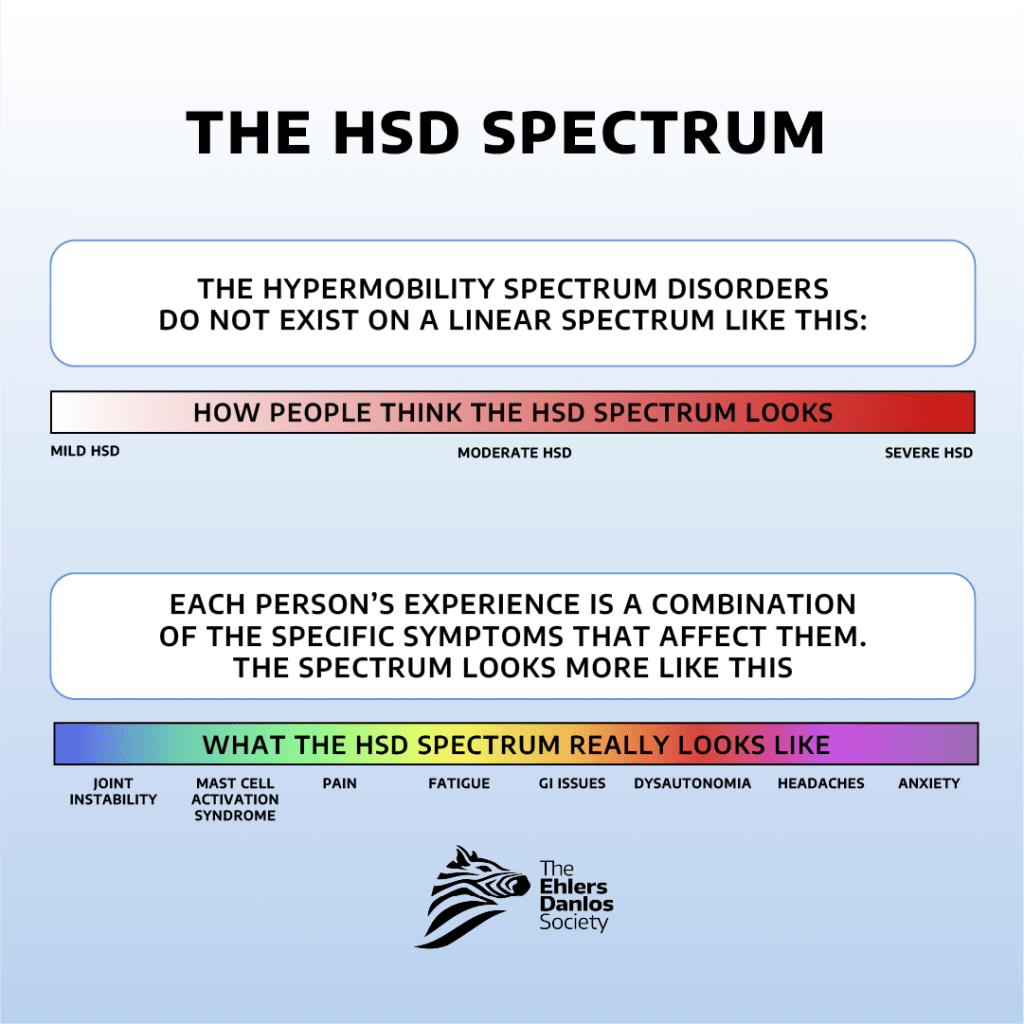
Adapted from The Ehlers-Danlos Society
Managing Hypermobility and HSD
While there is no cure, a correct diagnosis and a personalised treatment plan can significantly improve pain, function and quality of life.
Multidisciplinary care is often helpful and may include:
- GP
- Physiotherapist
- Exercise physiologist
- Occupational therapist
- Dietitian
- Specialists such as a cardiologist, gastroenterologist or neurologist
How Physiotherapy Can Help
Physiotherapy plays a central role in managing hypermobility spectrum disorder.
A tailored program may include:
- Targeted exercises to improve strength and joint stability
- Guidance on daily activities to reduce pain and strain
- Management of flare-ups such as sprains and soft tissue irritation
- Improving posture, movement patterns and proprioception
- Supporting fitness and fatigue management
You’re Not Alone: Where to Find Support
Joint hypermobility can be completely normal, but when it is associated with symptoms, it may indicate hypermobility spectrum disorder. Understanding the difference is key to getting the right support.
If you are experiencing pain, instability or fatigue alongside hypermobility, support is available and effective strategies can make a meaningful difference.
Book an Appointment
If this sounds like you, our team at Uplift Women’s Health Collective is here to help. We take the time to understand your body, your symptoms and your goals so we can create a personalised plan that supports you to move with more confidence and less pain (Book Now).