
Back to Blog

Stress urinary incontinence is one of the most common reasons women seek pelvic floor physiotherapy. Yet despite how common it is, many women are never properly taught why it happens.
If you’ve ever leaked urine when coughing, sneezing, laughing, running, jumping or exercising, you may have been told to “just do your pelvic floor exercises”.
While pelvic floor exercises can be an effective treatment, understanding why you are leaking is often the first step towards finding the right solution.
The reality is that stress urinary incontinence (SUI) can occur for different reasons. Understanding how the continence system works can help explain why some women develop leakage during exercise, pregnancy, postpartum or menopause.
In this blog, we’ll explain how your pelvic floor supports your bladder, what should happen when you cough or jump, and the two main reasons women experience stress urinary incontinence.
What Is Stress Urinary Incontinence?
Stress urinary incontinence (SUI) is the involuntary leakage of urine during activities that increase pressure inside the abdomen.
Common triggers include:
- Coughing
- Sneezing
- Laughing
- Jumping
- Running
- Lifting weights
- Exercise and sport
SUI is common during pregnancy, after childbirth and during menopause. It is also common in female athletes and women participating in high-impact exercise.
The pelvic floor has to work particularly well in these situations, not only contracting strongly, but also relaxing effectively and responding quickly to changing loads.
While leakage is common, it is not something you simply have to accept as normal.
How Your Pelvic Floor Supports Your Bladder
To understand why leakage occurs, it helps to understand how the continence system is designed to work.
Three key structures work together to keep urine in the bladder:
The Pelvic Floor Muscles
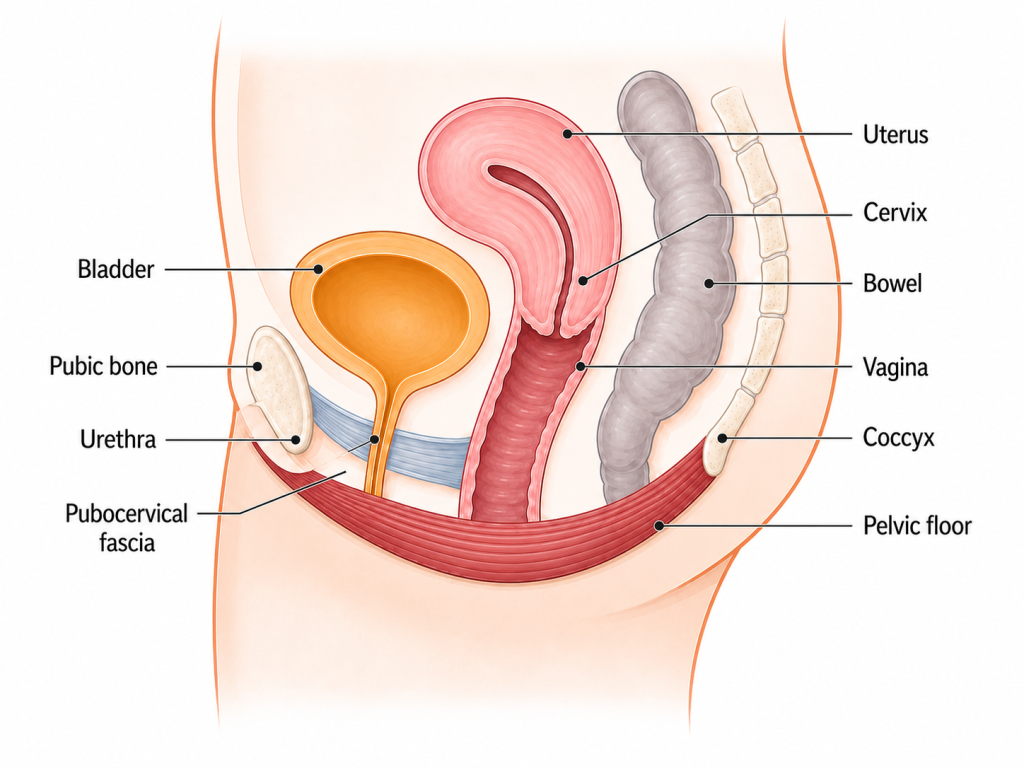
The pelvic floor muscles sit at the base of the pelvis and support the bladder, bowel and reproductive organs.
Many people think of the pelvic floor as a single muscle whose only job is to squeeze. In reality, it is a group of muscles with several important roles.
The larger pelvic floor muscles, known as the levator ani, help support the bladder and provide a stable foundation underneath the pelvic organs.
When these muscles contract, they help support the bladder and tension the support structures that sit beneath it.
They also respond automatically during activities such as coughing, sneezing, lifting and exercise.
The Fascia Behind the Urethra
One of the most important structures involved in continence is a layer of connective tissue called the pubocervical fascia.
This fascia sits between the bladder and urethra at the front, and the vaginal wall behind.
Think of this fascia like a firm supportive wall sitting behind the urethra.
When the pelvic floor contracts, it tensions this fascia and creates a stable backstop behind the urethra.
This support is incredibly important because it allows the urethra to be compressed and closed effectively when pressure increases inside the abdomen.
Without this supportive backstop, the urethra has less resistance behind it and may not close as effectively during activities such as coughing, running or jumping.
The Urethral Sphincter
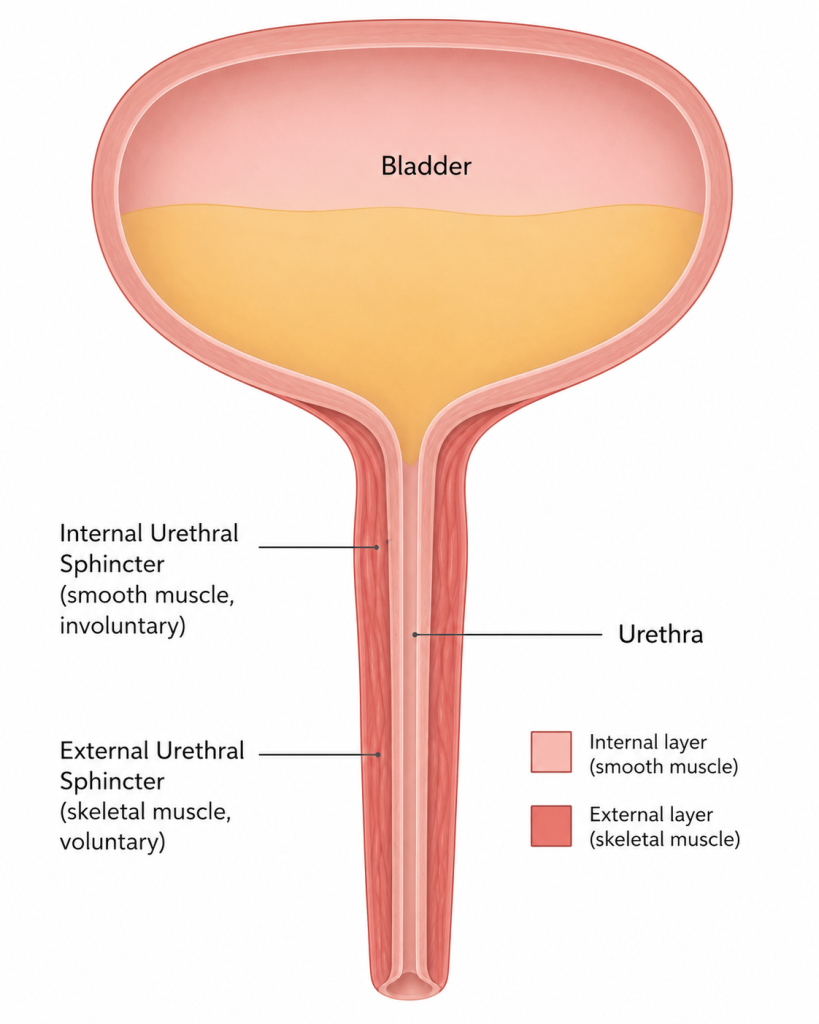
The urethral sphincter is the structure that directly closes the urethra and helps keep urine inside the bladder.
You can think of it as the bladder’s valve.
When functioning well, the urethral sphincter generates closure pressure around the urethra and helps prevent leakage when pressure inside the abdomen increases.
Like other muscles in the body, the urethral sphincter can become weaker, less responsive or less effective over time.
This is one reason why some women continue to leak despite having reasonable pelvic floor support.
What Should Happen When You Cough?
A cough creates a sudden increase in pressure throughout the abdomen.
For continence to be maintained, several things need to happen at the same time.
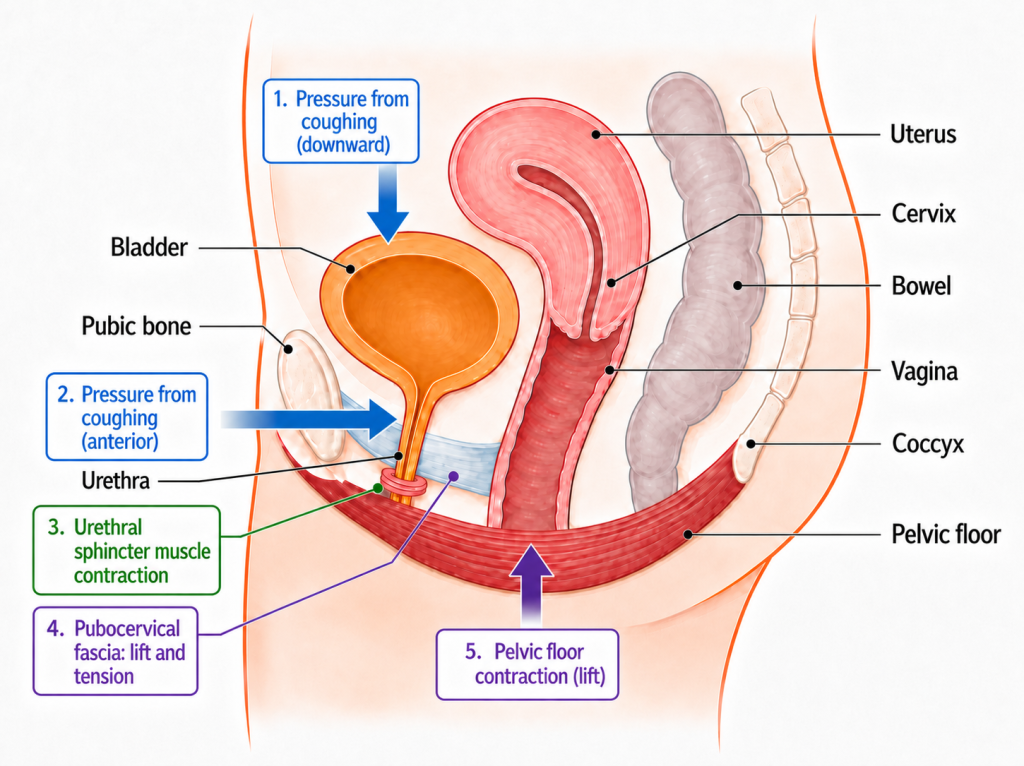
First, the pelvic floor contracts automatically.
As it contracts, it tensions the pubocervical fascia and helps support the bladder.
The bladder is lifted slightly up and forward.
At the same time, the urethral sphincter contracts to increase closure pressure around the urethra.
When the pressure from the cough travels through the abdomen, it doesn’t just push down on the bladder. The pressure also travels around the front of the urethra.
Because the fascia behind the urethra has been tensioned by the pelvic floor, the urethra can be compressed against this firm supportive backstop.
This creates additional closure pressure and helps prevent leakage.
When all parts of the system are working well, the pressure generated by the cough actually helps keep the urethra closed.
When any part of this system is not functioning effectively, urine leakage can occur.
The Two Main Types of Stress Urinary Incontinence
While every woman’s presentation is unique, stress urinary incontinence generally falls into one of two broad categories:
- A support problem
- A sphincter problem
Some women have a combination of both.
Understanding which mechanism is contributing to your leakage is often the key to understanding why symptoms occur.
Type 1: A Support Problem
For some women, the main issue is inadequate support around the bladder and urethra.
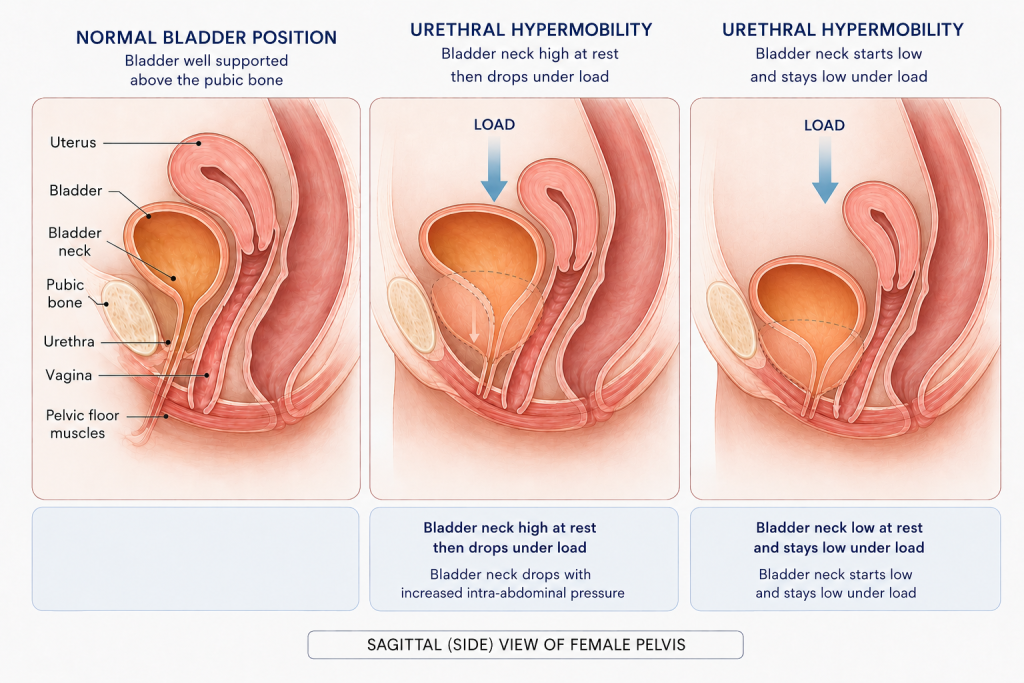
This is often referred to as urethral hypermobility.
In a well-supported system, the pelvic floor contracts and tensions the fascia behind the urethra. This allows pressure from a cough, sneeze or jump to help compress the urethra closed.
When support is reduced, the bladder and urethra can move excessively during these activities.
As pressure is applied during a cough, sneeze, jump or lift, the bladder moves downwards rather than remaining well supported.
Because the pelvic floor is not adequately lifting and supporting the bladder, the pressure from the cough predominantly acts on the top of the bladder.
The pressure is no longer effectively transferred around the front of the urethra to compress it against the supportive fascia behind.
As a result, the bladder is squeezed but the urethra does not receive the additional closure pressure it needs to stay closed.
This can result in leakage despite the urethral sphincter itself functioning reasonably well.
Common contributors may include:
- Pregnancy-related changes to connective tissue support
- Vaginal birth
- Pelvic organ prolapse
- Reduced pelvic floor support
- Connective tissue laxity
- High-impact sporting loads
Type 2: A Sphincter Problem
For other women, the support system may be functioning reasonably well, but the urethral sphincter itself is not generating enough closure pressure.
This is called intrinsic sphincter deficiency.
The urethral sphincter acts like a valve. If that valve cannot close strongly enough, leakage may occur despite reasonable pelvic floor support.
In this situation, the bladder and urethra may be positioned relatively well, but the urethral closure pressure is simply not high enough to resist the increase in pressure created by a cough, sneeze, jump or lift.
Women with this presentation often describe leakage during lower-level activities than would typically be expected.
Some women notice leakage with walking, standing from a chair or gentle exercise.
The urethral sphincter can be influenced by:
- Childbirth-related changes
- Ageing
- Menopause
- Reduced blood flow to the tissues surrounding the urethra
- Nerve injury affecting the sphincter muscles
- Changes to the supportive tissues surrounding the urethra
Sometimes It Is Both
Many women have a combination of support issues and sphincter weakness.
This is particularly common following pregnancy and childbirth, during menopause, or after years of participating in high-impact exercise.
For these women, there is rarely a single cause for their symptoms.
This is one reason why a thorough assessment is so important.
Strength Is Not the Same as Support
One of the biggest misconceptions about stress urinary incontinence is that leakage always means your pelvic floor is weak.
In reality, some women with stress urinary incontinence can generate a strong pelvic floor contraction during assessment.
The challenge is that continence depends on more than muscle strength alone.
The pelvic floor muscles, fascia, urethral sphincter and connective tissues all need to work together.
A woman may have good strength but reduced support from the fascia.
Another woman may have good support but reduced urethral sphincter function.
A third woman may have both.
This is why two women with seemingly identical symptoms can require completely different treatment plans.
Understanding which part of the system is contributing to your leakage is often the key to finally finding an effective treatment approach.
Understanding the Cause Is the First Step
Many women assume that leaking means their pelvic floor is weak.
As you’ve learnt, the reality is often more complex.
The pelvic floor, fascia and urethral sphincter all play important roles in keeping the bladder closed.
When one part of the system isn’t functioning optimally, leakage can occur.
Understanding why you are leaking is often the first step towards finding the right treatment approach.
In Part 2 of this series, we’ll explore why pelvic floor exercises don’t always work and the factors that can influence leakage during pregnancy, postpartum, menopause and throughout the menstrual cycle.
Book an Appointment
If you’re experiencing leakage with coughing, sneezing, running, jumping, lifting or exercise, our women’s health physiotherapists can help identify the underlying cause of your symptoms.
Book online via our website (Book Now) or call us on (03) 8828 4761 to speak with our team and arrange an appointment.
Learn more about how pelvic floor physiotherapy may support your recovery.